The Night Watch has been cut down, slashed with a knife and sprayed with acid, and right now a team of conservators is taking off its varnish in a glass room while visitors watch. The public sees the glass. A concierge can get you the people behind it.
Rijksmuseum
Museumstraat 1, Amsterdam

A painting with scars
Rembrandt finished The Night Watch in 1642, a commission from Captain Frans Banninck Cocq and seventeen members of his militia company. The painting has had a rough life since. In 1715 it was cut down on all four sides so it would fit between two columns in Amsterdam's town hall; two figures on the left disappeared for good. In 1911 a man tried to slash it and the thick varnish saved it. On 14 September 1975 a visitor attacked it with a bread knife and left zig-zag cuts of up to 30 centimetres. In 1990 someone sprayed acid on it, which only reached the varnish.
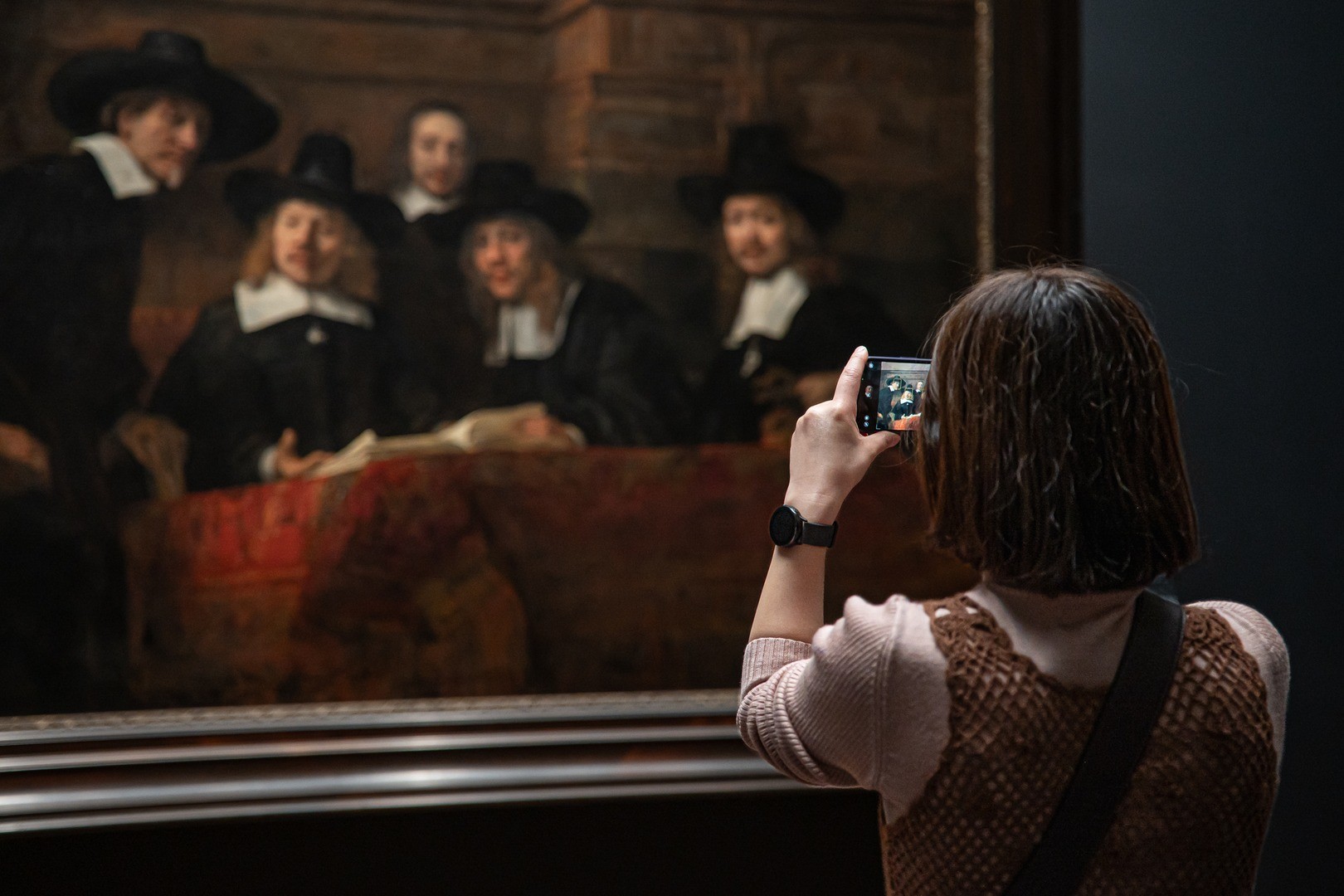
The Syndics, Rembrandt's group portrait of 1662, in the Rijksmuseum
Operation Night Watch
In July 2019 the Rijksmuseum started the largest research and restoration project ever devoted to the painting, and it did so in public: the work happens inside a glass chamber in the Night Watch Gallery. Five years of research came first, with digital imaging, scientific analysis, computer science and artificial intelligence. In 2021 the museum used that work, and a seventeenth-century copy by Gerrit Lundens, to show the strips lost in 1715 for one summer.
On 12 November 2024 a team of eight conservators began removing the varnish: the layers applied after the 1975 attack and remnants of older ones. They press a tissue with solvent against the surface for a short, measured time so the varnish dissolves into it, then continue under a microscope with cotton swabs. Anyone who visits can watch it happen.

An art historian in front of Rembrandt's portraits of Marten Soolmans and Oopjen Coppit
What a private programme adds
Watching through the glass is impressive. Hearing how it is done from someone who does it is something else. In the programme we call Behind the Canvas, a senior restorer with more than 25 years at the museum takes a small group into the craft: how you read a seventeenth-century surface, why a varnish yellows, what you leave alone. Then an art historian walks the group through the Gallery of Honour, from The Night Watch to Rembrandt's wedding portraits of Marten Soolmans and Oopjen Coppit and The Syndics, with time for the questions guests never get to ask on a public tour.

A group in front of The Syndics in the Gallery of Honour
The morning can end with a drink and a bite at RIJKS, the museum's own restaurant, or continue with galleries and ateliers in the city for groups who want more art and fewer old masters.

A story told up close, away from the crowds
Practical
Group size: small groups, so everyone can hear and see. Larger groups are split with their own guide each.
Best moment: early, when the galleries are at their quietest.
Combines well with: lunch at RIJKS, a private gallery walk, or a salon boat back to the hotel.
Availability of restorers and private access always depends on the museum's own schedule; we confirm in advance and never promise what the museum has not agreed.
Sources
Rijksmuseum press release, 12 November 2024: Restoration begins of Rembrandt's The Night Watch.
Rijksmuseum, Operation Night Watch project page.
Wikipedia, The Night Watch (commission, 1715 trimming, attacks of 1911, 1975 and 1990, 2021 reconstruction).
Endless Minds programme description Behind the Canvas.
Taco Dibbits, director of the Rijksmuseum, November 2024
Partner in this story
Rijksmuseum
Museumstraat 1, Amsterdam
Want to experience this with your own team?
Tell us the occasion and the number of guests, or call us on +31 6 42 60 21 03. We will tell you honestly whether we are the right partner, and what it would take.